
E-bikes are now common, but many people don’t realise that there are restrictions around what you can legally ride on the road. To understand whether your e-bike is suitable for commuting or leisure riding on public roads, you need to understand the specifications, and you can’t always tell from the product photos.
An electric bike looks straightforward on a product page: a motor, a battery, an advertised range figure and polished photographs. The surprises tend to appear later. The frame may feel too long, the battery may run flat sooner than expected, or the box may contain a bike needing assembly. Investigate those gaps before paying. A reliable listing should make the dull details easy to find, not leave them buried in a photo gallery.
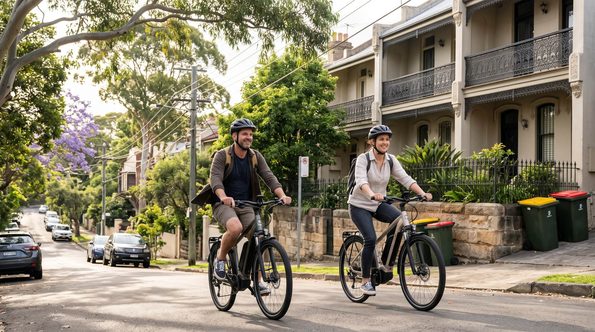
Before choosing from an e-bike online store, write down where the bicycle will actually go. Include the distance to work, the steepest hill, whether you carry shopping and where you can safely charge it. Then compare those everyday requirements with the specifications. A bike suited to a flat 5 km commute in Adelaide may be an awkward match for a hilly journey through Hobart.
Start with the Journey, Not the Motor
Your daily route determines what matters. For a 12 km round trip, comfortable handling and dependable brakes may matter more than a headline range of 100 km. Someone travelling along unsealed regional roads will pay closer attention to tyres, ground clearance and puncture resistance. A commuter using trains needs to consider station access and whether the bike can be lifted.
Look at the riding position, not simply the advertised frame size. Standover clearance, saddle adjustment and handlebar reach affect comfort. Ask for the manufacturer’s geometry chart, with measurements in millimetres, and compare it with a bicycle you already ride. If possible, try a similar frame style before ordering. Even a short ride can reveal pressure on your wrists or an uncomfortable reach to the brakes.
Check State Rules Before Ordering
A high motor-output figure is not automatically a benefit. In Victoria, a standard electrically power-assisted cycle has a maximum continuous rated output of 250 watts, with pedal assistance cutting out at 25 km/h. A walk-assist function may operate up to 6 km/h.
New South Wales currently permits certain electrically power-assisted cycles rated up to 500 watts, but is moving towards EN 15194 requirements for road use from 1 March 2029. State and territory rules differ. A product being advertised online does not automatically make it legal on public roads and paths.
Understand Queensland’s New Age and Sales Rules
Queensland introduced two important changes in 2026. Since 31 August, riders generally must be at least 16 and hold a valid driver licence, including a Learner licence, to ride an e-bike independently. Equivalent interstate and overseas licences are recognised. Exceptions include supervised riding for 12–17-year-olds, certain recreational areas and eligible riders with medical or disability exemptions.
A separate law took effect on 1 July 2026: e-mobility devices, including e-bikes, cannot be sold to buyers under 16 in Queensland. The restriction covers private and commercial sales, including online orders and retailers based in other Australian states selling to Queensland customers. Commercial sellers must request proof of age and take reasonable steps to confirm buyers are at least 16. Buyers should expect this check before checkout is completed. Sellers must also display notices explaining the age restriction, including on online product listings or checkout pages.
Translate Battery Claims into Useful Numbers
Battery capacity is measured in watt-hours (Wh). Multiply nominal voltage by amp-hours: a 36 V, 14 Ah battery stores approximately 504 Wh. At an illustrative consumption of 12 Wh per kilometre, that suggests about 42 km before reserving extra charge. It is a calculation, not a guaranteed range.
Hills, headwinds, rider weight and assistance settings change consumption. Ask how a quoted range was tested. Consider the return journey, not just the ride out. A removable battery can simplify charging; check its weight, replacement price and future availability.
Verify Electrical Safety Before Checkout
NSW requires affected e-micromobility vehicles, lithium-ion batteries and chargers sold in the state to meet prescribed product safety rules. Since 1 February 2026, applicable products must be certified and carry approval markings. Request the approval details if the listing does not clearly identify them.
Documentation should identify the exact bike, battery and charger combination. Standards such as EN 15194 and UL 2849 address defined requirements, but a standards logo alone is not evidence of certification. Fire and Rescue NSW advises using a compatible approved charger, charging away from exits and combustible materials, and avoiding charging while asleep or away from home.
Check Storage and Assembly Requirements
A 24 kg bicycle is harder to carry upstairs than a 17 kg one. Both weights are illustrative. Check whether the listed weight includes the battery, pedals, rack and lights. Measure your lift, doorway and bicycle storage area. Folding models are not always lightweight, and dimensions matter in a narrow hallway. If stairs are unavoidable, consider the effort of moving the bike after every trip, even in poor weather.
Delivery to your door also does not mean road-ready. Confirm whether wheels, pedals and handlebars arrive fitted and whether a mechanic should perform the final assembly. Brake adjustment, axle security and steering components deserve professional attention if you are uncertain. Ask how delivery damage is reported and who pays for transporting a damaged or faulty bike.
Calculate the Full Cost, Not Just Checkout Price
Consider a hypothetical $2,400 bike with $150 delivery, $120 assembly, an $90 lock and $80 for lights or bags. The total is $2,840, before future maintenance or battery replacement. These are illustrative costs, not quoted market prices.
The Australian Competition and Consumer Commission requires transparent pricing, including unavoidable charges. Keep a dated copy of the listing, specifications and invoice. Ask where local mechanics can obtain replacement parts and whether the seller has an Australian contact address and ABN.
Know Your Consumer Rights
Australian Consumer Law protects eligible online purchases, not only purchases in physical shops. A major failure generally allows the consumer to choose a refund or replacement; a minor problem may be repaired first. A change of mind does not automatically entitle the buyer to a refund, although retailers can offer more generous policies.
Before ordering, check the seller’s warranty process and who arranges freight if a fault develops. Overseas businesses selling to Australians may still have obligations under Australian Consumer Law, although resolving problems across borders can be harder.
The point of this homework is not to complicate shopping. It is to make the first ride pleasantly ordinary: a bike that fits, stops properly, climbs your usual hill and can be serviced when something wears out. Product photographs help you shortlist. Legal requirements, measurable specifications and a few direct questions help you decide.
References
1. Transport Victoria — Electric Bikes: Rules and Safety Requirements
https://transport.vic.gov.au/road-and-active-transport/active-transport/bicycles/electric-bikes
2. NSW Government — Choosing a Legal E-Bike
https://www.nsw.gov.au/driving-boating-and-transport/roads-safety-and-rules/bicycle-safety-and-rules/road-rules-for-bicycle-riders/choosing-a-legal-e-bike
3. NSW Fair Trading — E-Micromobility Product Safety Standards
https://www.nsw.gov.au/business-and-economy/running-a-business/selling-goods-and-services/supplying-e-micromobility-products
4. Fire and Rescue NSW — E-Bike and E-Scooter Battery Safety
https://www.fire.nsw.gov.au/fire-safety/home-fire-safety/topics/ebikes-escooters-battery-safety
Official battery charging, storage and fire prevention recommendations.
5. Australian Competition and Consumer Commission — Buying Online
https://www.accc.gov.au/consumers/buying-products-and-services/buying-online
6. Queensland Government — E-Bike Rules in Queensland
https://www.qld.gov.au/transport/safety/rules/wheeled-devices/electric-bicycle-rules
7. Queensland Government — Rules for Selling E-Mobility Devices
https://www.qld.gov.au/transport/buying/selling-emobility-devices


